
Why Zero Export Meters Are Essential in European Solar and Hybrid Power Systems
Zero export meters help control grid feedback in European solar systems with bidirectional measurement, fast response, and stable communication.
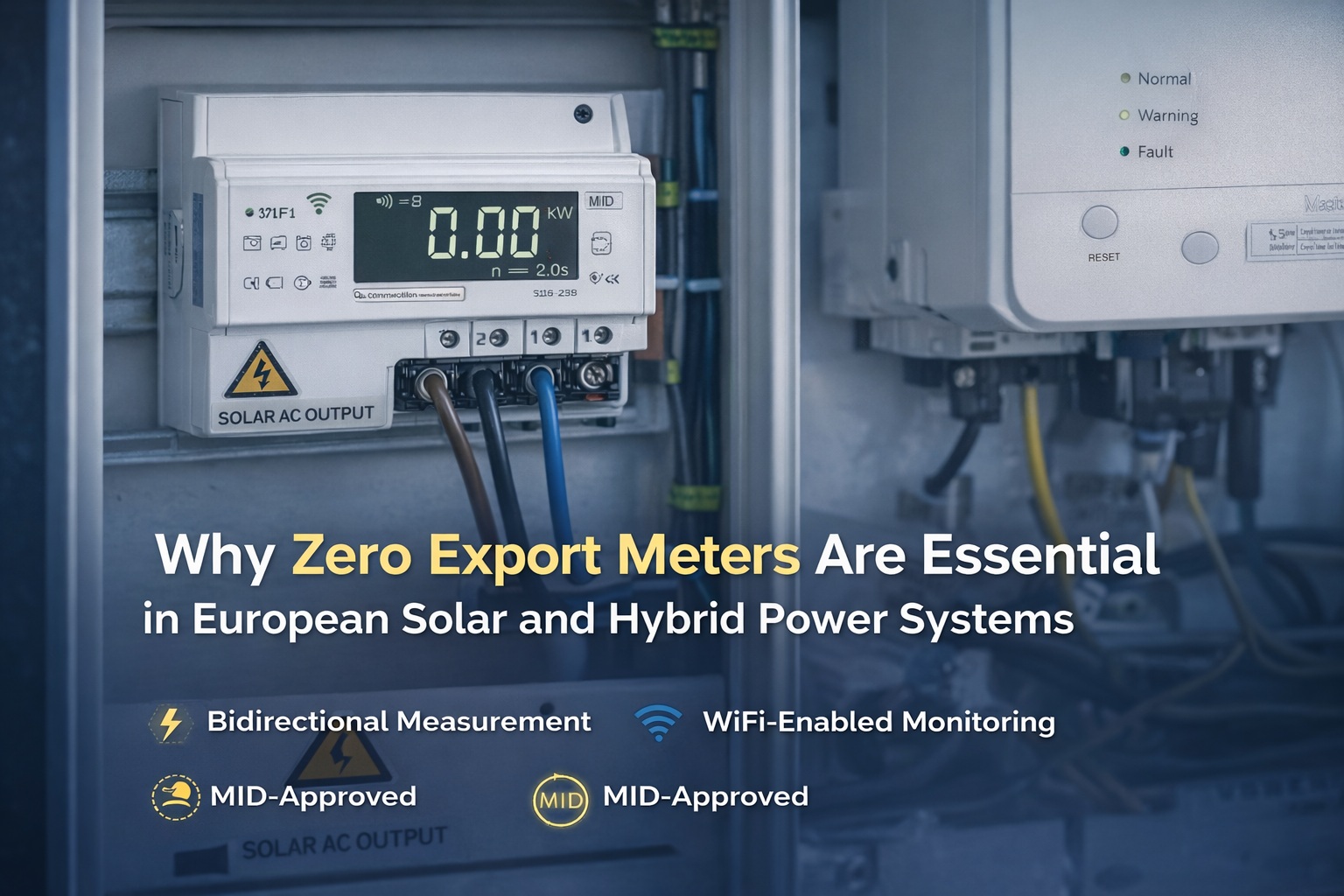
Why Zero Export Meters Are Essential in European Solar and Hybrid Power Systems
In European PV and energy storage projects, “zero export” is not just a feature on a datasheet. It is a real control requirement.
Many residential and small commercial systems are designed to maximize self-consumption while preventing excess power from being fed back into the public grid. In these cases, the inverter cannot manage export limitation accurately on its own. It needs a reliable reference point at the grid connection.
That is where the zero export meter comes in.
A properly selected zero export meter gives the inverter real-time visibility of power flow at the point of connection. It tells the system whether the site is importing power, exporting power, or sitting near balance. Without that information, “no export” control becomes slow, unstable, or simply unreliable in real operating conditions.
From an engineering standpoint, this is the key point: zero export control is only as good as the measurement signal behind it.
What Is a Zero Export Meter?
A zero export meter, also referred to as an anti-export meter, no export meter, or bidirectional energy meter, is installed to measure the real-time power flow between the site and the utility grid.
Its purpose is straightforward:
- detect the direction of power flow
- measure active power at the grid connection point
- send that data to the inverter or energy management system
- support dynamic output control so exported power remains at or near zero
This is very different from a conventional billing-only meter. In a solar or hybrid application, the meter is part of the control loop. It is not there just to accumulate kWh. It is there to provide a fast and accurate operating signal.
For this reason, features such as bidirectional measurement, single-phase DIN rail mounting, 100A direct connection, WiFi communication, and MID approval are highly relevant in export-limiting applications.
Why Zero Export Meters Matter in Europe
In many European markets, customers cannot freely export excess PV power to the grid.
This may be due to:
- utility restrictions
- local grid connection rules
- lack of export approval
- self-consumption-only project design
- weak local grid conditions
- commercial preference to avoid reverse flow
In practice, many systems described as “off-grid” are not truly isolated systems. They are often better described as:
- hybrid solar systems
- battery storage systems with grid backup
- self-consumption PV systems
- solar-plus-storage systems with export limitation
As long as a system remains connected to the public grid in any form, export control becomes relevant.
If PV generation rises and site load suddenly drops, excess power will flow toward the grid unless the inverter receives a fast enough signal telling it to reduce output. That signal comes from the zero export meter.
Bidirectional Measurement Is the Foundation
For a zero export meter function to work properly, the meter must be able to measure power in both directions.
That means it must clearly identify:
- power imported from the grid
- power exported to the grid
- real-time active power magnitude
- system condition near the zero-export threshold
This sounds simple, but it is a basic requirement that cannot be compromised. If the meter cannot distinguish import from export correctly, the inverter has no reliable basis for output control.
In solar applications, bidirectional measurement is not optional. It is the foundation of anti-export logic.
This is why a meter intended for zero export applications should support:
- import/export energy measurement
- real-time active power monitoring
- stable communication with the inverter or EMS
- accurate directional detection under changing load conditions
Why Fast Data Refresh Is Just as Important as Measurement Accuracy
A common mistake in product selection is to focus only on whether the meter can measure bidirectional energy, while ignoring how fast it updates and communicates data.
From a control perspective, refresh speed is critical.
Site conditions can change quickly:
- an EV charger stops charging
- a heat pump cycles off
- a water pump starts
- a battery switches charging status
- cloud movement changes PV output within seconds
If the meter reports too slowly, the inverter is always reacting to old data. By the time output is reduced, reverse power may already have been sent to the grid.
In real projects, this is where many “zero export capable” systems fail to perform cleanly.
A meter used for export limitation should therefore do more than measure accurately. It should also provide:
- fast real-time power updates
- reliable communication
- stable behavior under dynamic load conditions
- good compatibility with inverter control logic
This is especially important in residential and light commercial systems, where load changes are frequent and sometimes abrupt.
From an engineering point of view, the meter is effectively a feedback sensor in a closed-loop control system. If the feedback is delayed, control quality drops immediately.
Why MID Approval Still Matters
For Europe, compliance is part of product credibility.
A MID approved energy meter is generally more acceptable for projects where measurement quality, regulatory confidence, and market suitability matter. Even when the meter is used mainly for control rather than billing, MID approval still strengthens the product’s position in the market.
For installers, EPCs, and distributors, this matters for several reasons:
- it supports confidence in measurement performance
- it improves product acceptance in European projects
- it helps align with customer expectations for certified equipment
- it reduces concerns during technical review and project approval
Where a project specification calls for certified metering hardware, MID approval is often a strong advantage rather than just a marketing detail.
Typical Applications for a Zero Export Meter
Residential Solar PV Systems
Where homeowners want to maximize self-consumption without feeding excess energy into the grid.
Hybrid Inverter Systems
Where the inverter must coordinate PV generation, battery charging, site load, and grid interaction.
Battery Energy Storage Systems
Where charge/discharge behavior changes dynamically and grid exchange must be controlled in real time.
Retrofit Solar Projects
Where export permissions may not be available, but the customer still wants to install PV and reduce grid dependence.
Small Commercial Installations
Where load profiles fluctuate during the day and stable export limitation is required.
In these types of systems, the meter is not just a monitoring accessory. It is a functional part of system control.
What to Look for When Selecting a Zero Export Meter
1. Bidirectional Active Power Measurement
This is the first requirement. The meter must reliably detect both import and export conditions.
2. Real-Time Parameter Visibility
The meter should provide live values such as:
- active power
- voltage
- current
- power factor
- frequency
- energy consumption and import/export data
The inverter can only make good decisions if the input data is complete and current.
3. Communication Capability
A smart meter used for export limitation must communicate reliably with the control system. Depending on the application, communication may be via WiFi, RS485, or another supported method.
The key point is not the protocol name alone, but whether the communication is stable and fast enough for control use.
4. Installation Suitability
For many European residential projects, compact DIN rail mounting is preferred. A single-phase DIN rail energy meter with 100A direct connection is often well suited for standard distribution boards.
5. Compliance and Market Acceptance
For Europe, MID approval and recognized technical standards are important. These details can affect not only end-user confidence, but also distributor acceptance and project suitability.
6. Inverter Compatibility
This is often overlooked. Even a technically capable meter will not perform well if integration with the inverter is poor. Register mapping, refresh cycle, communication settings, and control logic compatibility all matter.
Why Zivopower Zero Export Meter Solutions Fit This Application
For export-limiting solar and hybrid systems, the meter should combine practical installation, accurate directional measurement, and stable communication in one device.
A Zivopower single-phase WiFi energy meter configured for solar applications is designed around exactly these priorities:
- bidirectional measurement for import/export detection
- 100A direct connection for practical residential use
- single-phase DIN rail design for compact installation
- WiFi communication for smart monitoring and integration
- multi-parameter measurement including W, V, A, PF, Hz, and kWh
- MID-approved configuration for stronger European market suitability
In engineering terms, these are not cosmetic features. They are the characteristics that determine whether a zero export function works properly in the field.
Common Misunderstanding: Zero Export Does Not Mean Static Zero at Every Instant
This is worth clarifying.
In real-world systems, zero export does not mean the power at the grid point remains mathematically fixed at exactly 0W every millisecond. All control systems have response time, and all sites have dynamic changes.
What matters is whether the system can:
- detect reverse flow quickly
- respond fast enough
- keep export close to zero over normal operation
- avoid sustained unwanted backfeed into the grid
A well-designed system will keep the grid exchange tightly controlled around the zero point, with only minimal short-duration fluctuation when site conditions change rapidly.
That is why meter quality matters so much. Better measurement and faster communication lead directly to better export control.
Conclusion
In European solar and hybrid energy systems, a zero export meter is not an optional add-on. It is a critical control component.
If the project requires self-consumption, restricted export, or no backfeed to the grid, the inverter needs a reliable meter at the point of connection. That meter must do more than count energy. It must detect direction, update quickly, communicate reliably, and support stable inverter control.
From a practical engineering perspective, the key selection criteria are clear:
- bidirectional measurement
- fast real-time data refresh
- reliable communication
- suitable installation format
- MID approval or equivalent market-ready compliance
- proven compatibility with inverter-based control
A well-matched Zivopower zero export meter helps the system respond correctly to changing site conditions and maintain clean, stable anti-export performance.
In short, if the goal is to stop solar power from unintentionally feeding into the grid, the quality of the meter is not secondary. It is central to whether the solution actually works.
FAQ
What is a zero export meter?
A zero export meter is a bidirectional energy meter used to measure real-time power flow between a site and the utility grid, helping the inverter prevent unwanted power export.
Why is bidirectional measurement important in solar systems?
Because the inverter must know whether the site is importing power or exporting excess solar energy in order to control output correctly.
Is MID approval important for a solar energy meter in Europe?
Yes. MID approval improves product acceptance and supports confidence in applications where metering quality and European market suitability matter.
Can a WiFi energy meter be used for zero export control?
Yes, provided the meter offers reliable communication, bidirectional measurement, and fast enough data refresh for the inverter control system.
Where is a zero export meter typically installed?
It is usually installed at the grid connection point or main distribution board, where it can measure the actual power exchange between the site and the utility.