
How to Choose a Portable EV Charger for Home Use
Learn how to choose the right portable EV charger for home use, including Type 2 compatibility, 7kW charging, adjustable current, safety features, and solar integration.
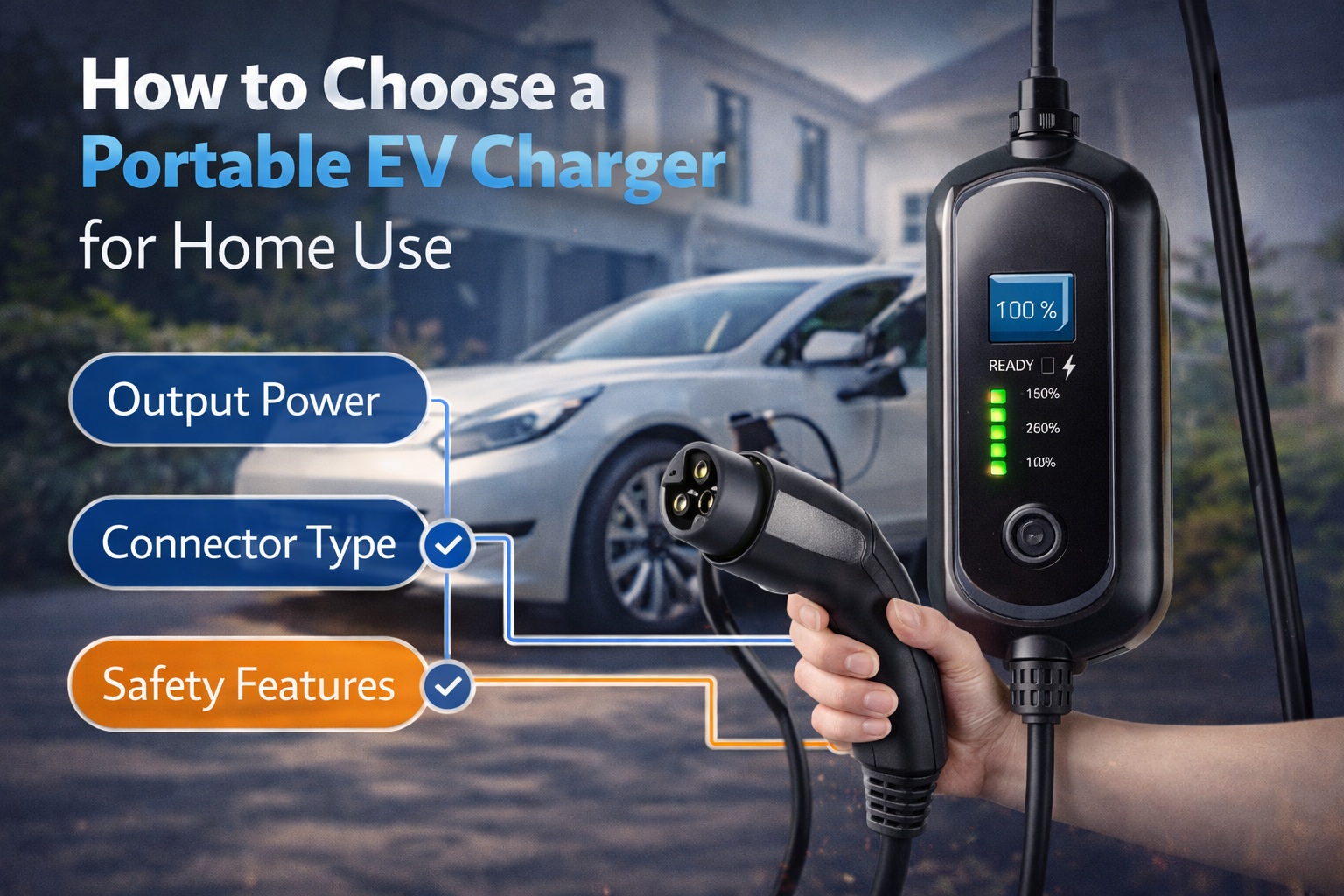
How to Choose a Portable EV Charger for Home Use
As electric vehicles become more common across Europe, home charging has become a basic requirement rather than an optional convenience. For many users, a portable EV charger is the most practical starting point because it combines mobility, simple setup, and compatibility with everyday residential charging conditions.
Compared with a fixed wallbox, a portable EV charger can be used in a garage, driveway, outdoor parking area, or temporary charging location. It is also a useful backup charging device for travel. In technical terms, the right product selection should not be based on appearance alone. It should be based on power rating, connector standard, current adjustability, protection design, cable quality, and compatibility with the home electrical system.
This guide explains how to select a reliable portable electric car charger or EV charger for home use from an engineering point of view.
1. What Is a Portable EV Charger?
A portable EV charger is a movable AC charging device designed to connect an electric vehicle to an available power outlet through an integrated control and protection unit. In practical use, this kind of product is often referred to as a portable electric car charger, portable EV charging cable, or Mode 2 EV charger.
A typical unit includes a power plug, an in-cable control box, a charging cable, and a vehicle-side connector. Unlike a wall-mounted charger, it does not require permanent installation, which makes it suitable for:
- home garages
- driveways
- temporary parking areas
- travel and backup charging
From an engineering perspective, the main benefit is deployment flexibility. As long as the outlet, grounding, circuit protection, and load capacity are appropriate, a home EV charger in portable format can cover most day-to-day residential charging needs.
2. Charging Power: Match the Charger to the Home Supply
The first point to evaluate is charging power. This affects charging time directly and determines whether the charger is actually suitable for the site conditions.
| Charger Type | Power | Current | Typical Use |
|---|---|---|---|
| Basic Portable Charger | 3.5 kW | 16A | Basic home and backup charging |
| Standard Portable Charger | 7 kW | 32A | Mainstream residential charging |
| Fast Portable Charger | 11 kW | 3-phase | Homes with three-phase supply |
For many European households, a 7kW portable EV charger is the most balanced option. It offers faster charging than lower-power units while still fitting many residential applications. An 11 kW model can charge faster, but it usually requires three-phase power. If the home only has single-phase supply, the charger rating alone will not improve real charging performance.
In other words, charger power should match both the available electrical infrastructure and the onboard charging limit of the vehicle.
3. Connector Type: Type 2 Is the Correct Choice for Most of Europe
For AC charging in Europe, Type 2 EV charger configuration is the mainstream standard. Type 2 is widely used for European passenger EVs and is the standard most buyers should check first when selecting a Type 2 portable EV charger.
Before ordering any portable EV charger, confirm that the vehicle inlet matches the charger connector. In most European applications, that means choosing a Type 2 EV charger. This avoids compatibility issues and makes the charger suitable for the majority of current AC charging scenarios.
4. Adjustable Current Is More Important Than Many Buyers Realize
A fixed-output charger may work under ideal conditions, but in real residential use, adjustable current is often the safer and more practical option. A good adjustable current EV charger usually offers settings such as:
- 8A
- 10A
- 13A
- 16A
- 32A
This matters because different homes, outlets, and temporary charging locations do not always allow the same load. By reducing current, the user can lower socket stress, reduce cable temperature rise, and avoid overloading a limited circuit. For households with varying electrical conditions, this function gives a portable EV charger for home use much better real-world adaptability.
5. Safety Protection Is a Core Technical Requirement
Any home EV charger should be evaluated first as an electrical safety product, not as a convenience accessory. A reliable portable EV charger should include protection against:
- overcurrent
- overvoltage
- leakage current
- overtemperature
- short circuit
These functions protect the charger, the vehicle, and the residential circuit. If the charger will be used outdoors or semi-outdoors, enclosure durability and stable protective performance become even more important. Two products may look similar externally, but their internal protection design, components, and long-term reliability can differ significantly.
6. Cable Length and Outdoor Durability
Cable length has a direct effect on installation flexibility. A charger that is electrically suitable but too short for the parking layout will be inconvenient in daily use.
Most models are available in cable lengths from 5 m to 10 m. A longer cable provides more parking flexibility, especially in driveways or shared parking spaces, but it also increases storage volume and handling weight.
For practical home use, the charging cable should have:
- strong insulation
- good mechanical strength
- UV resistance
- weather resistance
These points are essential if the portable electric car charger will be used outside on a regular basis.
7. Smart Functions Should Support Real Use, Not Just Marketing
Many products now include an LCD display and basic smart control features. In most cases, the most useful functions are:
- real-time charging status
- adjustable current setting
- delay charging timer
- session information display
- WiFi or app monitoring
For homeowners using time-of-use electricity tariffs, delayed charging can be especially useful. A charger that clearly shows operating current, charging status, and fault indication is usually more valuable than one with excessive software features but weak electrical design.
8. Solar Compatibility for Residential Energy Systems
As more households install rooftop PV systems, many buyers now look for a portable EV charger that can work well with solar generation. In this case, the charger should preferably support:
- adjustable charging current
- flexible operating modes
- compatibility with smart energy management
- easy relocation between charging positions
If solar output changes throughout the day, a charger with adjustable current is easier to coordinate with available generation. This makes a portable EV charger for home especially useful in residential solar charging applications.
9. Portable EV Charger vs Wall-Mounted EV Charger
There is no universal answer here. The correct choice depends on how the charger will actually be used.
Portable EV charger advantages:
- easy installation
- lower initial cost
- travel-friendly mobility
- flexible use in multiple locations
Wall-mounted EV charger advantages:
- cleaner installation
- higher fixed charging capacity
- dedicated daily charging point
- better cable management
For many homeowners, a portable EV charger is the more practical first solution because it allows charging to start immediately without committing to a permanent installation.
10. What to Check Before Buying
Before selecting a portable EV charger, confirm the following:
- available household power supply
- single-phase or three-phase compatibility
- vehicle connector type
- required charging speed
- adjustable current availability
- safety protection functions
- cable length and cable durability
- outdoor suitability
- solar compatibility if required
The best EV charger for home use is not simply the highest-rated model. It is the charger that matches the vehicle, the circuit, the outlet condition, and the user’s charging habits with the fewest compromises.
Portable EV Charging Solutions from Zivopower
Zivopower provides reliable EV charging products for residential charging, distribution projects, and international market supply. Our solutions include:
- portable EV charger
- Type 2 EV charger solutions
- portable EV charging cable products
- solar-compatible home EV charger solutions
- related charging accessories
If you are looking for a dependable portable electric car charger, a Type 2 portable EV charger, or a flexible EV charger for home applications, Zivopower can provide technical support and customized supply solutions for different market requirements.