Why a CE Certificate Alone Is No Longer Enough | Zivopower
Learn why CE certificates alone are not enough for EU sourcing. Zivopower helps reduce supplier and quality risks before shipment.
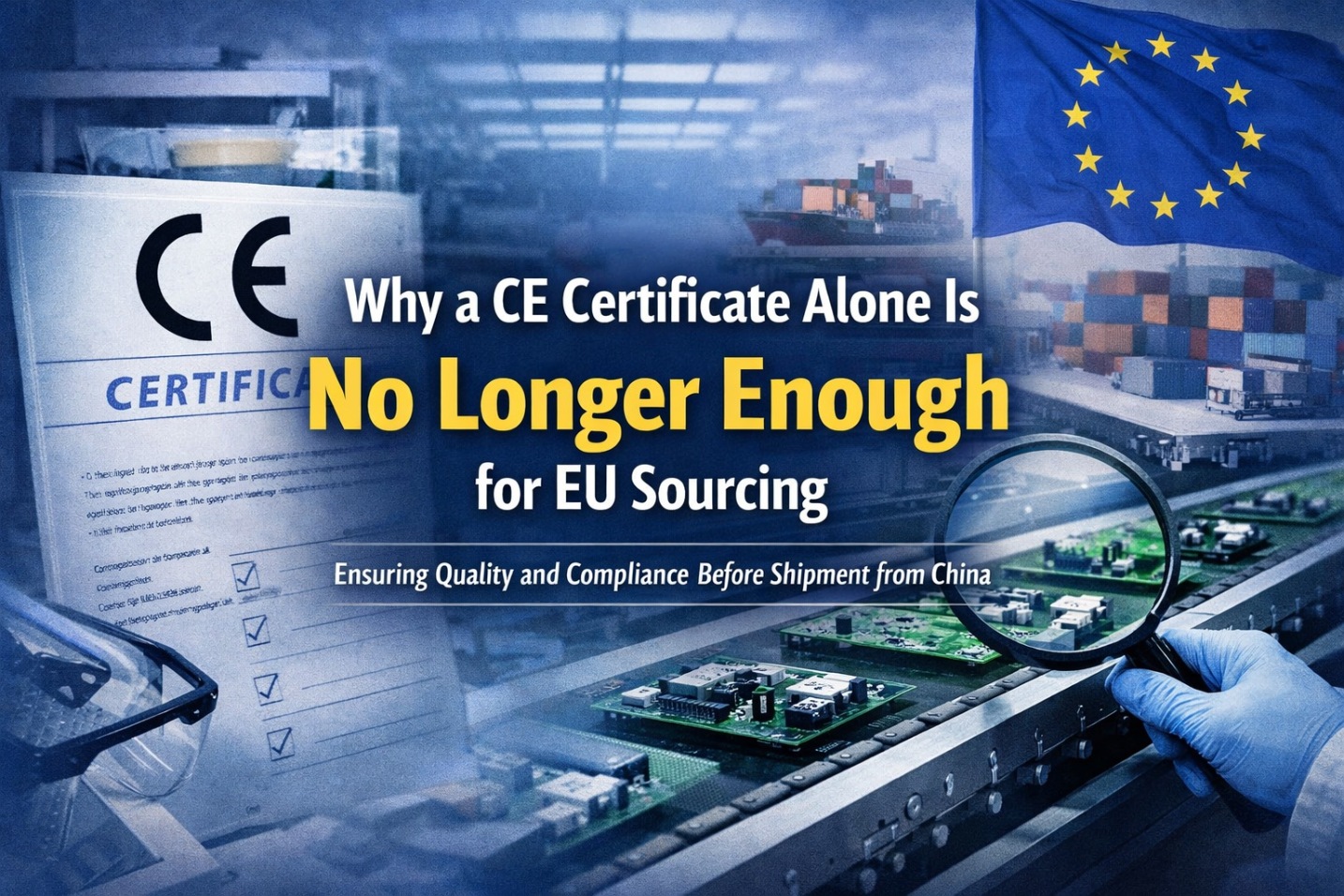
Exporting to the EU is no longer just about having a CE certificate. Today, buyers need to look deeper into whether a supplier’s quality system is actually operating, whether mass production matches tested samples, and whether potential risks can be identified before shipment. For international sourcing, document review alone is no longer enough. What matters more is consistency, traceability, and front-end risk control.
Why a CE Certificate Alone Is No Longer Enough
For EU market sourcing, the real question is whether the supplier’s system is genuinely working
In recent years, electrical products, PV components, and new energy products exported to the EU have been facing increasingly strict compliance and audit requirements.
Many buyers still begin supplier evaluation by checking the usual basic documents, such as business licenses, test reports, CE certificates, BOMs, product photos, and datasheets. These documents are important, but in today’s market environment, they are no longer sufficient on their own to determine whether a supplier is truly reliable.
The reason is simple: for the EU market, the risk is no longer limited to whether a product has a certificate. The more important issue is whether the quality system behind that certificate is actually functioning, whether mass production is consistent with the tested sample, and whether quality control is truly implemented in daily operations.
That is why more and more audits are no longer just document reviews. They are moving toward deeper verification of system operation, process closure, production consistency, and traceability.
Audit focus is shifting from “Do the documents exist?” to “Does the system really work?”
In the past, many companies treated annual audits as a routine exercise. The certification body would visit the factory, review the lab, production line, warehouse, and office, and then verify a set of basic documents. If there were no obvious issues, the certificate could usually be renewed without major difficulty.
Today, the logic has clearly changed.
More and more certification bodies are no longer satisfied with reviewing only high-level documents such as:
- Business licenses
- Test reports
- BOMs
- Certificate copies
- Product datasheets
Instead, they want to verify whether the supplier’s quality system is actually operating in a real and consistent way. This often includes checking:
- Incoming material inspection records
- Production records and process traceability
- Finished goods inspection records
- Nonconformity handling and corrective actions
- Equipment maintenance, checking, and calibration records
- Design change and process change control
- Shipment records linked to production batches and inspection data
From an audit perspective, these requirements are not simply about making the process more difficult. They are intended to answer a much more important question:
Does the tested and approved sample truly represent the products that will be manufactured and delivered in volume?
If that question cannot be answered with confidence, then even a complete document package does not eliminate purchasing risk.
Why having a CE certificate does not automatically mean lower sourcing risk
In real procurement work, many problems do not come from a total lack of documents. They come from situations where the document package looks acceptable on the surface, but the supplier’s actual delivery capability and quality control system are weak or inconsistent.
Common risks may include:
- Test reports that do not fully match the actual sales model
- Document versions that are outdated while the product has already changed
- Qualified sample configuration, but different materials or components in mass production
- Certificates are available, but process control records are incomplete
- A formal quality system exists on paper, but there is little evidence of real implementation
- Labels, packaging, manuals, or warnings that do not fully meet target market requirements
These issues have one thing in common: they are often difficult to detect during quotation or early sampling, but they can become much more serious after shipment.
Once the goods have already left China, the cost of solving the problem usually increases significantly. This may involve:
- Customs delays
- Market access risks
- Project delivery delays
- Rework, replacement, or return costs
- Customer claims and complaints
- Damage to brand reputation
- Stricter follow-up audits and additional compliance pressure
From a procurement management perspective, effective control should not stop at collecting supplier documents. It should focus on identifying issues before shipment, verifying consistency, and reducing the probability of failure in mass delivery.
Why local pre-shipment control in China has become more important
For overseas buyers, supply chain issues are not always impossible to solve. The problem is that the later they are discovered, the more expensive they become.
If a problem is identified at the factory side in China, there is still room to correct it through document updates, label revisions, specification checks, batch confirmation, or production adjustments. But if the problem appears only after the goods reach an overseas warehouse, a project site, or the end market, the cost and complexity usually rise sharply.
That is why more buyers are paying attention to a practical question:
Before shipment, is there someone in China who can review the supplier from the buyer’s perspective and verify the basic qualifications, product-document consistency, and quality control status?
This kind of work does not always require a full system audit, but it does require the ability to assess issues such as:
- Whether the certificate matches the product
- Whether the report matches the actual model and rating
- Whether the document chain is logically consistent
- Whether the sample and mass production are aligned
- Whether key specifications are being correctly executed
- Whether the pre-shipment quality status can be reasonably confirmed
- Whether the supplier’s problem is a minor detail issue or a deeper system issue
This is where a China-side sourcing representative or procurement consultant can create real value.
How Zivopower helps reduce supplier qualification and quality risks
For international buyers, finding a supplier is usually not the hardest part. The harder part is reducing the risk of choosing the wrong one, approving the wrong configuration, or missing the warning signs hidden behind acceptable-looking documents.
At Zivopower, we do not define our value simply as introducing factories or forwarding prices. We focus more on helping buyers move part of the risk control work forward, before the goods are shipped.
If you are sourcing PV components, electrical accessories, or other new energy products from China, early-stage verification is often more cost-effective than solving problems after shipment. You may also want to review our related pages on China-side sourcing support and solar solution products.
1. Preliminary review of supplier certificates and qualifications
We begin by checking the supplier’s basic qualification documents, but we do not stop at whether the documents merely exist. What matters more is whether they are actually relevant to the product being offered.
This may include checking:
- Whether the certificate scope covers the actual product
- Whether the test report model, version, and parameters match the goods being quoted
- Whether the BOM and technical documents are logically consistent
- Whether labels, manuals, and declarations are aligned with target market requirements
This does not replace formal certification work, but it helps buyers detect obvious mismatches and high-risk points much earlier.
2. Basic assessment of whether the supplier’s quality system is really operating
A supplier cannot be judged only by smooth communication or by its ability to prepare a sample. A more meaningful question is whether its quality control system shows evidence of real operation.
Where practical, we pay attention to whether the supplier can provide a reasonable trace of routine control activities, such as:
- Incoming inspection records
- In-process inspection records
- Finished goods inspection records
- Nonconformity handling records
- Equipment checking and calibration records
- Change control records
- Shipment and batch traceability information
These records do not always need to be reviewed in full depth, but if even the basic logic does not connect, the stability of future mass production deserves caution.
3. Attention to consistency between sample and mass production
Many sourcing problems do not originate from the sample itself. They appear during the transition from sample approval to mass production.
Typical examples may include:
- Material substitution without sufficient notification
- Changes in accessories or technical configuration
- Differences in appearance, labeling, or packaging version
- Different execution standards between small-batch samples and bulk orders
For that reason, before shipment we try to help buyers reconfirm key specifications, key configuration points, and basic delivery details, so the risk of sample-pass but mass-production deviation can be reduced as much as possible.
4. Intercepting quality risks in China before they become overseas problems
For buyers, the most valuable support is not explaining a problem after it happens. It is reducing the chance that the problem leaves the factory in the first place.
In practice, this may include:
- Pre-shipment document review
- Checking labels, packaging, and manual information
- Confirming key technical specifications
- Rechecking alignment between sample approval and order execution
- Coordinating inspection, sampling check, or video inspection before shipment
- Reporting abnormal findings quickly and pushing for correction where needed
We do not claim that every risk can be eliminated. But we do try to move part of the risk discovery and problem solving stage forward, while the goods are still in China and corrective action is still more practical.
Why front-end supplier control matters more for EU projects
Today, the EU market is placing more emphasis on product safety, document authenticity, system operation, consistency, and traceability. This is unlikely to become looser in the future. More likely, the requirements will become more detailed and more practical.
Under these conditions, supplier decisions should not rely only on three things:
- The supplier says it has experience
- The documents look complete
- The quotation looks competitive
A more reliable sourcing approach is to check:
- Whether the documents truly match the product
- Whether the supplier shows signs of real system operation
- Whether sample and mass production are likely to remain consistent
- Whether risk can be moved forward and controlled before shipment
For overseas buyers, this kind of front-end control is often more valuable than saving a small amount on purchase price.
Purchase price is visible. But the cost of one compliance failure, one quality issue, or one mass-production inconsistency is often much higher than the small price difference that looked attractive at the beginning.
We do not promise zero risk, but we work to reduce the probability of failure
No cross-border sourcing project can be completely risk-free, especially when it involves electrical products, new energy products, system components, or multi-supplier coordination.
A professional approach is not to make unrealistic promises. It is to:
- Identify risks as early as possible
- Reduce deviations during execution
- Discover problems before shipment whenever possible
- Respond and correct quickly when issues appear
This is also how Zivopower defines its role.
We see ourselves as a China-side support partner for the buyer, helping with supplier screening, basic qualification review, pre-shipment control, and day-to-day supply chain coordination.
The goal is not to create unnecessary procedures. The goal is to help buyers discover issues earlier, reduce avoidable mistakes, and face fewer uncertainties after the goods arrive in the destination market.
The kind of support Zivopower wants to provide
Zivopower does not position itself as simply a product seller. We aim to be a practical support point for buyers on the China supply side:
- Helping identify more suitable suppliers
- Helping review basic qualifications and certificates
- Helping detect obvious mismatches and higher-risk issues
- Helping coordinate pre-shipment checking and confirmation
- Helping intercept quality risks in China as early as possible
Our objective is not to tell buyers that every supplier is perfect. Our objective is to do more of the detailed work earlier, so problems can be exposed earlier, risk can be reduced earlier, and the cost of correction can stay lower.
In long-term cooperation, this is often more valuable than simply obtaining a lower quotation.
Need China-side support before shipment?
If you are sourcing electrical products, PV components, or new energy accessories from China, Zivopower can help you review supplier qualifications, verify basic compliance documents, and reduce avoidable quality risks before shipment.
Contact Zivopower to discuss your sourcing project.