CPR Solar Cable Explained
EU’s CPR regulates solar cables in European PV projects for fire safety. It applies to building-installed cables, classifies fire performance, differs from IEC standards.
CPR Solar Cable Explained
For photovoltaic projects in Europe, cable selection is not only an electrical design issue. In many cases, it is also a building compliance issue.
A lot of installers are familiar with IEC cable standards and product certifications, but in real projects that is only part of the requirement. Once a cable is routed through a building, technical room, conduit, or other construction-related space, CPR may also apply. If that point is missed during procurement, the problem often shows up later during inspection rather than at the quotation stage.
That is why CPR should be understood as part of practical project design, not just as an extra certificate.
This guide explains what CPR is, why it matters for solar cable selection in Europe, and what installers should check before placing an order.
1. What Is CPR?
CPR stands for Construction Products Regulation (EU No. 305/2011).
In simple terms, it is the European regulation used to control how certain products perform when they are permanently incorporated into construction works. That includes electrical cables used within buildings and similar fixed installation environments.
From a solar installation perspective, the key issue is fire behavior.
CPR is intended to improve fire safety in buildings by classifying how cables behave in a fire, including factors such as:
- flame spread
- smoke emission
- heat release
- flaming droplets
- acidity of gases
If a cable falls within the scope of CPR, it must be supplied with the relevant CE marking and performance classification.
2. Why CPR Matters for Solar Cable
In rooftop PV projects, solar cable is not always routed only in open outdoor areas. In many installations, part of the cable run passes through building-related spaces, such as:
- cable ducts
- technical rooms
- service shafts
- indoor conduits
- building entry points
Once the cable becomes part of the building infrastructure, CPR can become relevant.
This is the point that often causes confusion. A cable may be fully suitable from an electrical standpoint, but still be non-compliant for the building installation route if it does not carry the required CPR classification.
In practice, this usually becomes an issue during inspection or document review.
3. How CPR Cable Classification Works
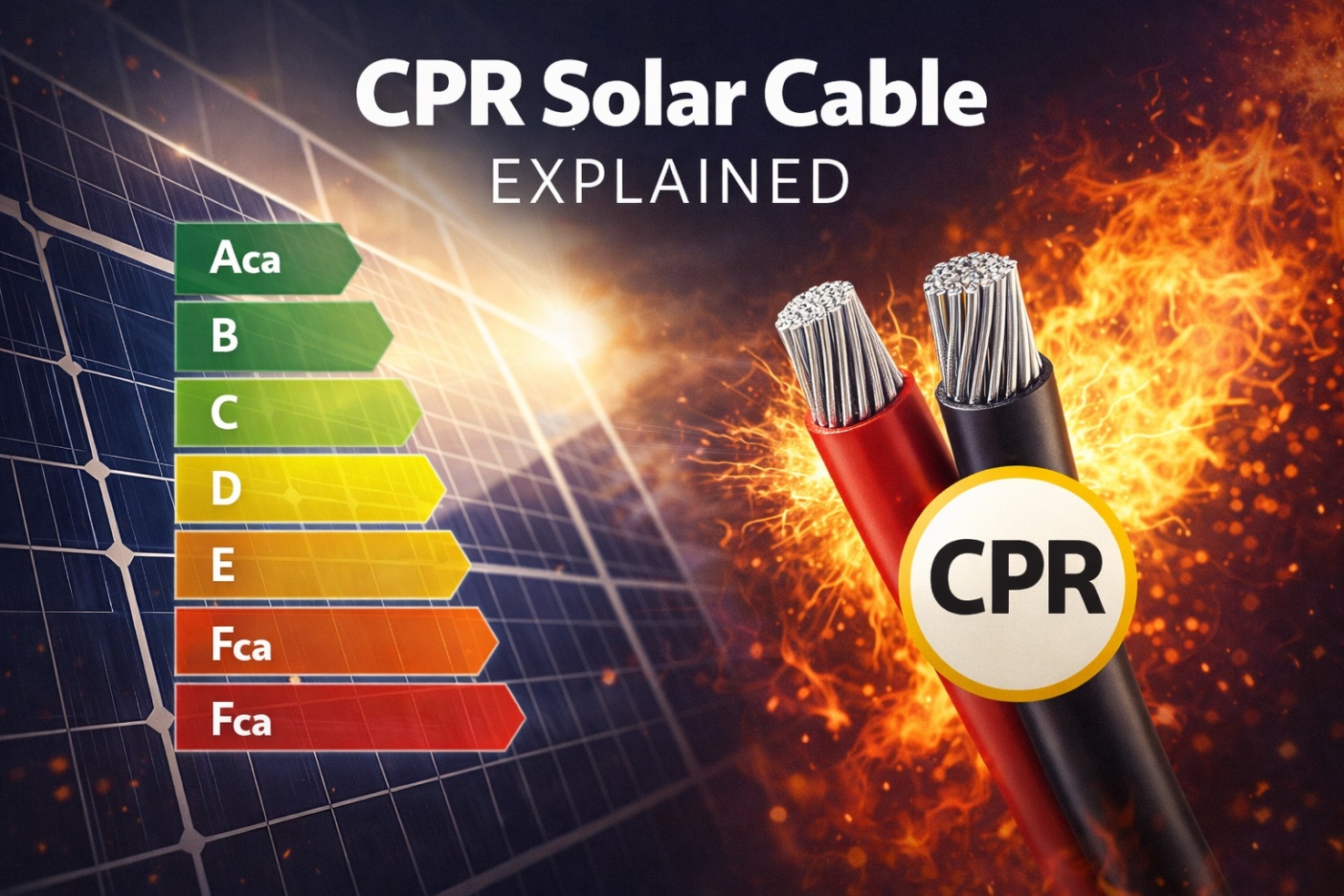
CPR classifies cables according to their fire performance. The main classes commonly seen in the market are:
| CPR Class | Fire Performance |
|---|---|
| Aca | Non-combustible |
| B2ca | Very high fire performance |
| Cca | Good fire performance |
| Dca | Standard fire performance |
| Eca | Basic flame resistance |
| Fca | No performance declared |
For many solar applications, the most common classes seen in actual procurement are Eca and Cca, although the required level depends on the country, building type, and installation location.
Engineers and installers should not assume that one class is acceptable for every project. The requirement may change depending on whether the cable is installed in a residential building, commercial facility, public building, or technical service area.
4. Additional CPR Indicators: s, d, and a
The main CPR class is only part of the designation. Cables may also carry additional performance indicators:
- s = smoke production
- d = flaming droplets
- a = acidity of gases
For example:
Cca-s1,d1,a1
This means the cable has:
- limited flame spread
- very low smoke production
- limited flaming droplets
- low acidity of emitted gases
From an installation standpoint, these additional parameters matter because they affect evacuation safety, smoke visibility, and corrosive gas exposure during a fire event. In projects such as schools, hospitals, commercial buildings, or public infrastructure, these details may be more important than installers first expect.
5. CPR Is Not the Same as IEC Solar Cable Compliance
This is one of the most common misunderstandings in the market.
Many installers correctly check whether a cable complies with IEC 62930 or carries TÜV certification for photovoltaic application. Those are important requirements, but they are not the same as CPR.
The difference is straightforward:
IEC and TÜV-related solar cable standards typically focus on:
- electrical performance
- voltage rating
- UV resistance
- weather resistance
- thermal durability
- suitability for PV operation
CPR focuses on:
- fire behavior when cable is installed as part of a building structure
So a cable can be suitable as a solar DC cable from an electrical perspective and still not satisfy the CPR requirement for a building installation route.
For many European projects, both requirements need to be checked separately.
6. When CPR Is Usually Required in Solar Projects
Whether CPR applies depends mainly on where the cable is installed.
In practical PV work, CPR is usually relevant when the cable is routed:
- inside buildings
- inside conduits within construction structures
- through technical rooms
- through indoor service areas
- through shafts, risers, or enclosed building spaces
For cable runs fully outside the building envelope, the situation may vary depending on national rules and project interpretation. That is why installers should not rely on assumptions alone. Local building regulations and project specifications should always be checked.
A mistake here is often not visible during installation. It usually appears later when the inspector asks for cable documents.
7. Common Compliance Mistakes on Site
Several avoidable mistakes show up repeatedly in European PV projects:
- using non-CPR cable inside a building
- assuming IEC certification automatically covers CPR
- ordering cable without checking the actual installation route
- failing to keep CPR documents available for inspection
- focusing only on price or lead time while ignoring compliance scope
These are not minor paperwork problems. They can delay approval, require partial replacement of installed cable, and create unnecessary cost late in the project.
8. How to Check Whether a Cable Is CPR Compliant
Before purchasing cable for a European installation, installers and buyers should verify at least the following:
- CE marking
- CPR classification
- Declaration of Performance (DoP)
- manufacturer technical documentation
- traceability between the product and the submitted documents
The important point is not just whether the supplier says the cable is compliant, but whether the supporting documents are complete and consistent enough for inspection and project records.
In real projects, documentation is often just as important as the cable itself.
9. Practical Advice for Installers and Buyers
For European solar projects, the safest approach is to confirm cable compliance based on the actual routing path before procurement starts.
In practical terms, that means:
- use CPR-classified cable when the routing passes through building-related spaces
- confirm local or project-specific building requirements
- keep DoP and related product documents ready for inspection
- avoid assuming that outdoor PV certification automatically covers indoor installation requirements
This check is simple at the design stage, but expensive if discovered after installation.
10. A More Practical Way to Avoid Delays
Most compliance problems with solar cable are not caused by complex engineering. They are caused by incomplete scope checking at the beginning of the project.
If the installer, distributor, or buyer confirms early whether the cable route enters the building structure, the CPR requirement can usually be addressed without difficulty. If that question is ignored, the issue often appears later when changing cable is no longer convenient.
From an engineering and procurement standpoint, early compliance confirmation is one of the easiest ways to avoid unnecessary delay.
Solar Cable Solutions for European Installations
Zivopower supports solar installers and distributors with products and documentation suited to European PV applications, including:
- IEC-compliant solar DC cables
- CPR-classified cable options
- PV connectors and related accessories
- project-based technical support
Our goal is to help customers simplify PV infrastructure sourcing while reducing compliance risk in real installation work.
Conclusion
In European photovoltaic projects, CPR is an important part of cable selection whenever the installation route involves building structures. It is not a replacement for IEC solar cable standards, and it should not be treated as the same thing.
The correct approach is to evaluate cable selection from both sides: electrical suitability for PV operation, and fire-performance compliance for the building environment. When both are confirmed early, installation and inspection become much more straightforward.