
Carbon Steel vs Aluminum Solar Carport Structure | How to Choose the Right Solar Carport Mounting System
Compare carbon steel and aluminum solar carport structures for strength, installation, corrosion resistance, and maintenance. Find the right solar carport mounting system for your project.
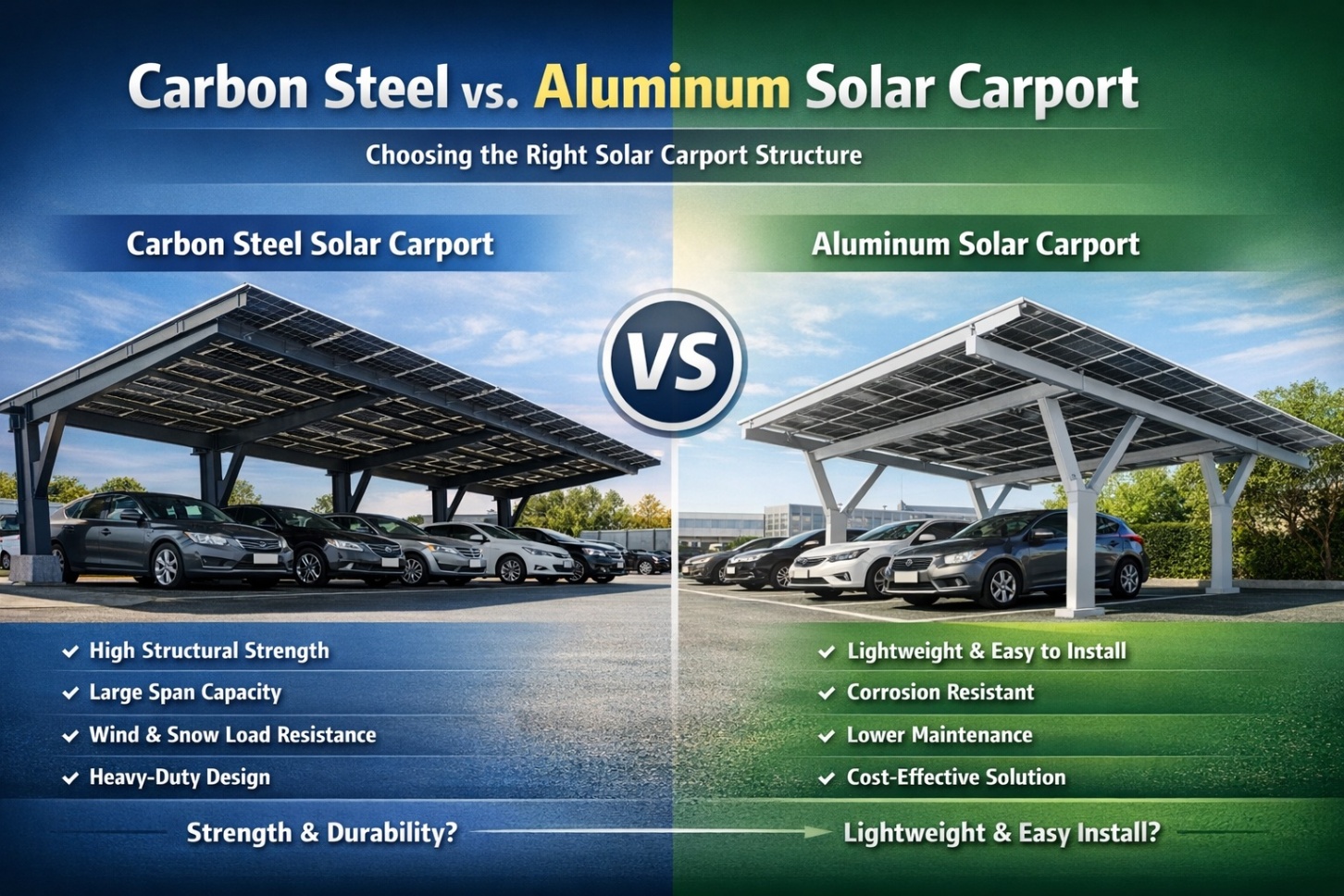
Carbon Steel vs Aluminum Solar Carport Structure | How to Choose the Right Solar Carport Mounting System
As someone who has been working with solar carports for years, I understand a simple reality: for EPC contractors, overseas distributors, and project procurement teams, choosing a solar carport structure has never been just a matter of comparing materials—carbon steel versus aluminum.
What really determines whether a project goes smoothly often comes down to details that are easy to overlook during the quotation stage: structural span, wind load, snow load, shipping efficiency, installation method, corrosion protection, drainage design, and what exactly is included in the supplier’s scope.
That is why experienced buyers rarely compare only the unit price of a solar carport mounting system. What matters more is whether the structure actually fits the project conditions and whether the quotations are based on the same technical assumptions.
At Zivopower, we treat a carport inquiry not as a request for a standard product, but as a small-scale structural engineering project. Once the parking layout, module type, climate conditions, and installation requirements are clear, the choice between carbon steel and aluminum becomes much more straightforward.
A Solar Carport Is More Than Just a Covered Parking Space
From a project perspective, a solar carport structure is essentially a load-bearing outdoor steel or aluminum system that serves two functions at once:
- Providing covered parking
- Supporting a photovoltaic system
That sounds simple enough, but in practice, the structure has to meet both architectural and PV mounting requirements simultaneously.
Compared to conventional rooftop or ground-mounted systems, a solar carport typically has more exposed structural elements, tighter constraints on drainage and finishing, and a more critical installation sequence. In commercial projects, it often also needs to integrate with EV chargers, cable routing, lighting, and traffic flow.
So for project buyers, the question is not whether the carport looks good in a brochure. The real question is whether the proposed PV carport structure can handle the project loads, suit the installation method, and meet the overall cost targets.
What Large-Scale Buyers Usually Care About
For residential buyers, appearance and convenience might be enough to make a decision. For distributors and EPCs, the evaluation logic is different.
In most B2B projects, buyers typically look at these points first:
- Is the solar carport structure suitable for local wind and snow loads?
- Is the material choice aligned with the required span and structural duty?
- Does the quotation cover only the structure, or does it include drainage, edging, and waterproofing?
- Is the packaging and loading efficient for export shipping?
- How much crane work or heavy lifting will be required on site?
- What anti-corrosion treatment is offered?
- Can the supplier adapt the structure to the selected PV module sizes?
- Can the supplier support repeat or high-volume procurement?
These are the factors that determine whether a carport structure remains competitive after factoring in freight, installation, and long-term maintenance.
Carbon Steel Solar Carport: When It Makes More Sense
Carbon steel solar carport structures are generally the better choice when the project prioritizes structural strength and span capability.
In practical terms, carbon steel is usually the safer direction if the project has one or more of the following characteristics:
- Larger span requirements
- Higher wind loads
- Higher snow loads
- Stronger demand for structural rigidity
- More customized heavy-duty layouts
- Preference for a more solid visual appearance
For commercial parking lots, industrial sites, logistics parks, and projects in demanding climate conditions, carbon steel often provides more margin on the structural side.
From a fabrication standpoint, steel also offers more flexibility when the structure needs to adapt to complex layouts or when the client expects a stronger architectural presence.
That said, carbon steel is not automatically the better commercial choice. Its disadvantages are clear:
- Heavier weight
- Larger packing volume
- Higher shipping costs
- More difficult on-site handling
- Greater dependence on lifting equipment during installation
For export projects, these factors directly affect container loading efficiency. For installation teams, they increase crane dependency and site labor complexity.
Another point that cannot be overlooked is corrosion protection. For outdoor solar carport systems, the steel structure must be evaluated together with its galvanization or surface treatment standard. This is especially critical in coastal, humid, or high-salinity environments. If this is not clearly confirmed, a lower initial price may not mean much in the long run.
Aluminum Solar Carport: When It Becomes the Better Option
Aluminum solar carport structures become more attractive when logistics, corrosion resistance, and installation efficiency take priority over maximum structural heaviness.
This is often the case in projects where:
- A lighter structure is preferred
- Shipping costs are a sensitive factor
- Installation speed matters
- On-site lifting conditions are limited
- Long-term corrosion resistance is a priority
- Maintenance workload should be minimized
The biggest practical advantage of an aluminum solar carport is not just its modern appearance. It is that it is easier to move, easier to assemble, and generally easier to manage on site.
For EPC teams, this translates to shorter installation time and lower handling complexity. For procurement teams, it improves loading efficiency and reduces some of the hidden costs outside the product itself.
Aluminum also offers better natural corrosion resistance, making it attractive for outdoor applications where maintenance access is limited or where the client wants a cleaner long-term appearance.
But aluminum has its limits.
Compared to carbon steel, it is generally less suitable for very large spans or for projects that require a heavier structural expression. If the design pushes too far on span or loading, aluminum may become less economical or less practical.
There is another point that often causes confusion during quotation comparison: many aluminum solar carport offers are based on the basic version only. That may mean the price does not include:
- Waterproofing
- Drainage channels
- Side edging
- Finishing details
So if one supplier offers a basic aluminum frame and another offers a more complete waterproof solar carport structure, those prices are not directly comparable.
Waterproofing Should Be Treated as a Defined Scope Item
This is one of the most common issues in solar carport inquiries.
Some buyers assume that once the structure covers the vehicle, waterproofing is naturally included. In reality, that is not always the case.
A waterproof solar carport depends on more than just the main frame. In most cases, it also depends on:
- Connection detail design
- Drainage paths
- Gutter arrangement
- Sealing methods
- Side finishing
- Installation quality
In other words, waterproofing is not just a material feature—it is a system detail.
If the project requires a waterproof solar carport structure, that requirement should be defined clearly early on. Otherwise, the quotation may cover only the load-bearing mounting structure, while the buyer assumes drainage and waterproof performance are already included.
For project work, this kind of scope mismatch is avoidable, but only if it is clarified early.
What Information Is Needed Before Asking for a Quotation
A useful quotation starts with a useful inquiry.
For a project-based solar carport supplier, the following information is usually needed before a meaningful offer can be prepared:
- Number of parking spaces
- Single-row or double-row arrangement
- Module type and dimensions
- Project country
- Wind load and snow load requirements
- Material preference: carbon steel or aluminum
- Whether waterproofing is required
- Anti-corrosion requirements
- Expected quantity
- Site installation conditions
Without these points, most quotations can only be considered preliminary.
This is especially true for EPC and project procurement work. A solar carport manufacturer can provide a faster reference price based on standard assumptions, but the quotation only becomes technically useful once the main project boundaries are defined.
What Distributors and EPC Buyers Should Compare
When comparing suppliers, it is better not to ask only which one is cheaper. A more practical comparison is:
- Which supplier is quoting the same scope?
- Which structure is more suitable for the project loads?
- Which option is easier to ship and install?
- Which supplier is clearer in technical communication?
- What anti-corrosion standard is being offered?
- Which option creates lower total project risk?
For high-volume buyers, these questions are usually more important than a small difference in base structure price.
A solar parking structure that looks cheaper at first may become more expensive after freight, on-site handling, waterproofing upgrades, and installation support are all taken into account.
Final View: Carbon Steel or Aluminum?
There is no single correct answer for every project.
If the project needs higher structural strength, larger spans, and better performance under demanding loading conditions, a carbon steel solar carport is usually the more reliable direction.
If the project needs lighter weight, easier transport, faster installation, and lower long-term maintenance, an aluminum solar carport is often the better fit.
In most cases, the material decision should come after the project conditions are clarified, not before.
For overseas distributors, EPC companies, and bulk procurement buyers, the real value of a supplier is not only in offering a solar carport mounting system, but in helping the buyer define the right scope, compare options fairly, and reduce risk before order confirmation.
That is the approach we believe makes more sense for project-based solar carport work.
FAQ for Zivopower Solar Carport Page (Project Procurement Edition)
Here is the FAQ section, rewritten to reflect the kinds of questions that come up in engineering and procurement scenarios.
1. What is included in your solar carport quotation?
It depends on the project scope. In some cases, the quotation covers only the main structure. In others, it may include connectors, drainage-related components, edging, and other accessories. For project comparisons, we recommend confirming the quotation scope line by line.
2. Do you offer both carbon steel and aluminum solar carport structures?
Yes. We offer both carbon steel and aluminum solutions. The right option depends on span, loading conditions, corrosion environment, installation method, and budget.
3. How do I choose between carbon steel and aluminum?
In general, carbon steel is more suitable for projects requiring higher strength, larger spans, or more demanding wind and snow load performance. Aluminum is usually more suitable when lighter weight, easier installation, and lower maintenance are priorities.
4. Is waterproofing included as standard?
Not always. A waterproof solar carport should be treated as a defined requirement. Waterproofing depends on drainage design, sealing details, connection treatment, and installation quality. It should be confirmed clearly before comparing quotations.
5. Can your solar carport structure be customized for different module sizes?
Yes. The mounting system can be adjusted according to module dimensions, parking layout, and project requirements. This is common in EPC projects using different framed PV modules.
6. What information do you need for an accurate quotation?
We typically need:
- Number of parking spaces
- Layout type
- Module dimensions
- Project location
- Wind load and snow load data
- Material preference
- Waterproofing requirements
- Expected order quantity
The clearer the input, the more useful the quotation.
7. Can you support bulk orders for distributors and EPC projects?
Yes. We focus on overseas B2B customers, especially distributors, EPC contractors, and project procurement teams. We support project-based communication for volume orders and repeat procurement.
8. What applications are your solar carport structures suitable for?
They are suitable for commercial parking lots, industrial projects, office buildings, warehouses, public facilities, and other sites where parking shelter and photovoltaic generation need to be combined.
9. What is the difference between a basic version and a full-featured version?
The basic version usually focuses on the main load-bearing structure. A more complete version may include drainage, edging, waterproofing-related details, and additional finishing. For procurement work, these should not be mixed in a single price comparison.
10. Can you help with loading estimation for export shipment?
Yes. Based on the structure type, material, and layout, we can provide a preliminary loading estimate for container shipment. This is especially important for high-volume procurement planning.
11. What should project buyers pay most attention to when comparing solar carport suppliers?
The main points are scope consistency, structural suitability, anti-corrosion standards, installation complexity, shipping efficiency, and communication clarity. In many projects, these points are more important than a small unit price difference.
12. Why work with Zivopower for solar carport projects?
Because project buyers usually need more than a brochure quotation. We focus on helping customers clarify project scope, compare carbon steel and aluminum options more realistically, and move toward a more workable procurement decision.